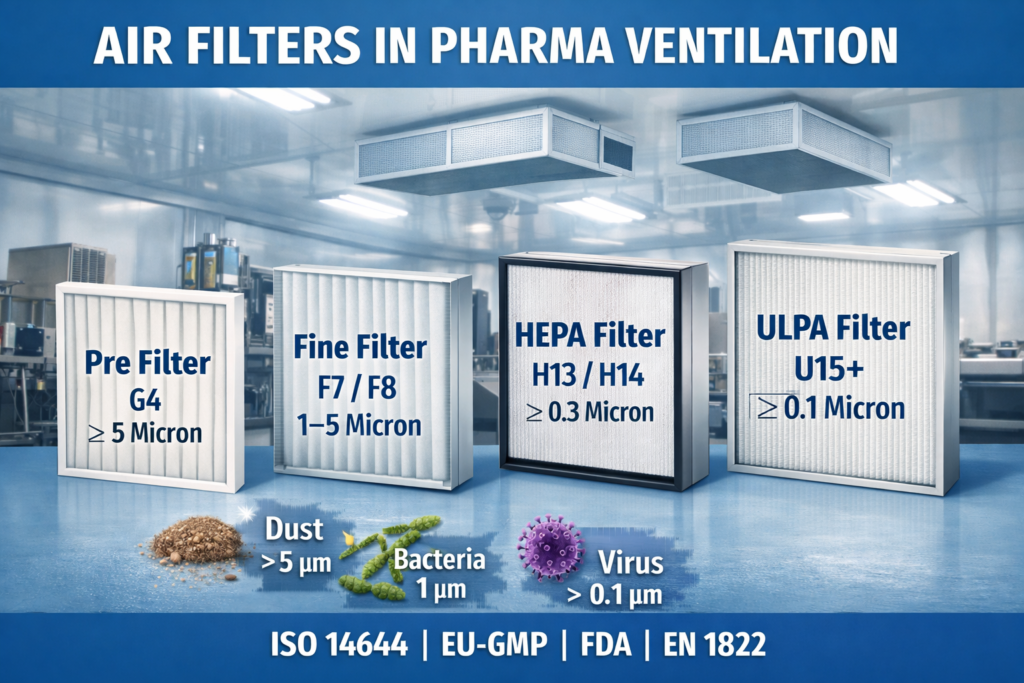
Air filtration is a cornerstone of HVAC systems in the pharmaceutical industry, ensuring compliance with cleanroom classifications, preventing microbial and particulate contamination, and safeguarding product quality, patient safety, and regulatory adherence. Key standards include ISO 14644-1 (particle limits), EU GMP Annex 1 (Grades A–D, revised August 2022), US FDA cGMP (21 CFR Parts 210/211 and aseptic processing guidance), EN 1822:2019 and ISO 29463 (high-efficiency filter classification and testing at MPPS), EN 779:2012 (coarse/medium/fine filters, now largely superseded by ISO 16890 but still widely referenced in pharma specifications), and regional alignments such as ANVISA (Brazil, RDC 658/2022) and PIC/S GMP (including India).
1. Purpose of Air Filtration in Pharma HVAC
Filters remove:
- Dust, fibers, and large particulates
- Microbes (bacteria ~1–5 µm, viruses ~0.1–0.3 µm)
- Aerosols and sub-micron particles
They maintain cleanroom classifications, control differential pressure, protect operators/products/environment, and meet GMP validation needs (e.g., integrity testing via PAO/DOP per EU GMP Annex 1 and ISO 14644-3).
2. Types of Filters in Pharma HVAC Systems
Pharma AHUs typically use 3-stage filtration (cascade design) to extend HEPA life and achieve required cleanliness:
| Stage | Filter Type (Common Names) | Typical Grades | Particle Size Targeted | Primary Use | Regional/Trade Names (e.g., India/Brazil) |
|---|---|---|---|---|---|
| Stage 1 | Pre-filters / Coarse filters | G1–G4 (EN 779:2012) | >5–10 µm | Initial dust removal from fresh air | Filtros grossos (Brazil); Coarse |
| Stage 2 | Fine / Medium filters | M5–M6, F7–F9 (EN 779:2012) | 1–5 µm | Secondary cleaning, protects HEPA | Filtros finos (Brazil); Microvee (India) |
| Stage 3 | HEPA / Absolute filters | H13–H14 (EN 1822:2019) | ~0.1–0.3 µm (MPPS) & below | Critical cleanroom supply (terminal) | Filtros absolutos / Absolute / HEPA (India/Brazil common term) |
| Advanced | ULPA | U15–U17 (EN 1822:2019) | ~0.12 µm (MPPS) | Ultra-critical zones (e.g., high-potency APIs) | Filtros absolutos ultra / ULPA |
Note on “Absolute” Filters: In pharmaceutical HVAC (especially in India and Brazil), HEPA filters (H13/H14) are frequently called “absolute filters” or “filtros absolutos” due to their near-absolute particle retention (≥99.95–99.995% at MPPS). This practical industry term highlights their role as the final barrier for critical cleanliness. It appears in manufacturer catalogs (e.g., Crescendo India, Flocon Industries, Map Filters India, Linter Filters Brazil) and is synonymous with HEPA in pharma contexts, though official standards use HEPA/ULPA.
3. Special/Regional Filter Types in Pharma HVAC
- Microvee Filters (or Micro Vee / Micro-Vee): A trade name popular in India for fine-efficiency V-bank or mini-pleat panel filters (typically F7–F9 equivalent under EN 779:2012 or ePM classes in ISO 16890). The name derives from the V-shaped (vee) media arrangement for increased surface area/lower pressure drop, plus “Micro” for finer particle capture (~3–5 µm at 95–99% efficiency, or better at 1–3 µm). Used as secondary/fine filters in AHUs.
- Typical Location: Mid-section of AHU filter banks or plenum (pressurized enclosure for even airflow), after coarse pre-filter but before coils/HEPA.
- References: Spectrum Filtration (spectrumfiltration.com – Spectra Microvee series), United Filters India, Chemfilt India – marketed for pharma HVAC, AHUs, cleanrooms.
- Bleed Filters (Bleed Air Filters): Functional term for HEPA-grade filters (H13/H14, EN 1822:2019) in bleed/exhaust paths. “Bleed” refers to diverting excess air to maintain positive pressure in cleanrooms (preventing ingress of contaminants). These ensure bled air is filtered to prevent environmental release.
- Typical Location: In AHU plenum’s exhaust/bleed section, near fan discharge, bleed dampers, or dedicated bleed plenum/duct — separate from main supply path.
- References: IPA India Guidance on Good Engineering Practices 2024 (ipa-india.org); pharma HVAC discussions (e.g., LinkedIn posts on Grade-wise AHU filtration mentioning ISO 40H (H13) bleed filters).
4. Detailed Filter Grades – EN 779:2012 (Coarse, Medium, Fine)
(Superseded by ISO 16890 but still widely referenced in pharma HVAC.)
| Grade | Group | Final Test Pressure Drop (Pa) | Average Arrestance (Am) – Synthetic Dust (%) | Average Efficiency (Em) at 0.4 µm (%) | Minimum Efficiency at 0.4 µm (%) | Typical Particle Size Targeted / Notes |
|---|---|---|---|---|---|---|
| G1 | Coarse | 250 | 50 ≤ Am < 65 | — | — | >10–50 µm; large dust/fibers |
| G2 | Coarse | 250 | 65 ≤ Am < 80 | — | — | >5–50 µm; basic visible dust |
| G3 | Coarse | 250 | 80 ≤ Am < 90 | — | — | >5–10 µm; good coarse dust |
| G4 | Coarse | 250 | 90 ≤ Am | — | — | >5 µm; common pre-filter (~85–98% at 10 µm) |
| M5 | Medium | 450 | — | 40 ≤ Em < 60 | — | 1–5 µm; ~15–50% at 1 µm |
| M6 | Medium | 450 | — | 60 ≤ Em < 80 | — | 1–5 µm; ~20–65% at 1 µm |
| F7 | Fine | 450 | — | 80 ≤ Em < 90 | ≥35 | 0.4–5 µm; ~45–75% at 0.5 µm |
| F8 | Fine | 450 | — | 90 ≤ Em < 95 | ≥55 | 0.4–3 µm; ~65–90% at 0.5 µm |
| F9 | Fine | 450 | — | 95 ≤ Em | ≥70 | 0.4–2 µm; ~75–95% at 0.5 µm |
5. Detailed Filter Grades – EN 1822:2019 (EPA, HEPA, ULPA)
Efficiency tested at MPPS (~0.1–0.3 µm).
| Grade | Group | ISO 29463 Equivalent | Integral Efficiency at MPPS (%) | Local Efficiency at MPPS (%) | Penetration at MPPS (%) | Pharma Use / Notes |
|---|---|---|---|---|---|---|
| E10 | EPA | — | ≥85 | — | ≤15 | Basic high-eff. |
| E11 | EPA | ISO 15 E | ≥95 | — | ≤5 | Transitional |
| E12 | EPA | ISO 25 E | ≥99.5 | — | ≤0.5 | Pre-HEPA |
| H13 | HEPA | ISO 35 H / 40 H | ≥99.95 | ≥99.75 | ≤0.05 / ≤0.25 | Grade C/D, ISO 7–8 |
| H14 | HEPA | ISO 45 H | ≥99.995 | ≥99.975 | ≤0.005 / ≤0.025 | Grade A/B, ISO 5–6 (aseptic standard) |
| U15 | ULPA | ISO 55 U | ≥99.9995 | ≥99.9975 | ≤0.0005 / ≤0.0025 | Biotech/high-risk |
| U16 | ULPA | ISO 65 U | ≥99.99995 | ≥99.99975 | ≤0.00005 / ≤0.00025 | Advanced R&D |
| U17 | ULPA | ISO 75 U | ≥99.999995 | ≥99.9999 | ≤0.000005 / ≤0.0001 | Extreme needs |
6. Standards Comparison: EU-GMP / ISO 14644 / FDA / EN1822 (with ANVISA/India Context)
ANVISA (RDC 658/2022) and IPA India GEP 2024 align with PIC/S/EU GMP.
| ISO Class | EU GMP Grade | At Rest / In Operation Particles ≥0.5 µm/m³ | Typical Filter Requirement | Notes |
|---|---|---|---|---|
| ISO 5 | Grade A | ≤3,520 | Terminal H14/ULPA | Aseptic filling |
| ISO 5–6 | Grade B | ≤3,520 / ≤352,000 | H14 (terminal) | Background |
| ISO 7 | Grade C | ≤352,000 | H13 | Non-sterile/secondary |
| ISO 8 | Grade D | ≤3,520,000 | F8/F9 + H13 | General manufacturing |
- FDA: Aligns with ISO/EU; requires HEPA-filtered air, integrity testing.
- References: EU GMP Annex 1 (2022, health.ec.europa.eu); EN 779:2012 & EN 1822:2019 (via Camfil insights camfil.com); ISO 16890/29463; IPA India GEP 2024 (ipa-india.org); Camfil (camfil.com), AAF, Spectrum Filtration (spectrumfiltration.com).
7. Typical HVAC Filter Arrangement in Pharma
Fresh Air → Coarse/Pre-filter (G4) → Fine/Microvee (F7/F8/F9) → AHU coils/humidifier → Secondary fine/HEPA → Terminal HEPA H14 / Absolute (ceiling modules, LAF, RABS, isolators) → Cleanroom. Bleed filters (H13/H14) on exhaust/bleed paths for pressure control.
8. Typical Filter Sizes (mm)
| Filter Type | Common Dimensions | Depth (mm) | Notes |
|---|---|---|---|
| Pre/Coarse | 610 × 610, 592 × 592 | 25–50 | Panel/bag |
| Fine/Microvee | 610 × 610, 592 × 592 | 150–300 | V-bank/pocket |
| HEPA/Absolute | 610 × 610, 1220 × 610 | 150–292 | Gel-seal or knife-edge |
| Terminal Modules | 1220 × 610, 610 × 610 | Varies | Ceiling-integrated |
9. Qualification, Testing, and Maintenance
Mandatory per EU GMP Annex 1, ISO 14644-3, IPA GEP: Initial/periodic integrity testing (PAO/DOP aerosol scan), particle counting, airflow/velocity/pressure differential, pressure drop monitoring, replacement based on life cycle.
10. Conclusion
Pharmaceutical HVAC relies on multi-stage filtration—coarse (grossos), fine (finos/Microvee), absolute/HEPA/ULPA, and bleed filters—to meet stringent cleanliness demands per ISO 14644, EU GMP Annex 1, FDA, EN 1822:2019, and regional frameworks (ANVISA/PIC/S, IPA India). Proper grade selection, terminal absolute/HEPA in critical zones, and rigorous testing ensure contamination control, regulatory compliance, and consistent product quality across sterile and non-sterile manufacturing. Always perform site-specific risk assessments and consult current guidelines/manufacturers (e.g., Camfil, AAF, Spectrum Filtration, local suppliers in Mumbai/India/Brazil) for updates and specifications.
The content in this article is based on the following official standards, regulatory guidelines, and reputable industry sources (accessed and cross-verified as of March 2026):
11. References:
Official Standards & Guidelines
- European Committee for Standardization (CEN). EN 779:2012 – Particulate air filters for general ventilation – Determination of the filtration performance.
- European Committee for Standardization (CEN). EN 1822:2019 – High efficiency air filters (EPA, HEPA and ULPA) – Parts 1 to 5.
- International Organization for Standardization. ISO 16890:2016 – Air filters for general ventilation (replaced EN 779 in many contexts).
- International Organization for Standardization. ISO 29463:2017–2022 – High-efficiency filters and filter media for removing particles in air – Parts 1 to 6.
- International Organization for Standardization. ISO 14644-1:2015 – Cleanrooms and associated controlled environments – Part 1: Classification of air cleanliness by particle concentration.
- International Organization for Standardization. ISO 14644-3:2019 – Test methods.
- European Commission. EU GMP Annex 1: Manufacture of Sterile Medicinal Products (Revision effective 25 August 2023). Available at: https://health.ec.europa.eu/system/files/2022-08/20220825_gmp-an1_en_0.pdf
- U.S. Food and Drug Administration (FDA). Guidance for Industry – Sterile Drug Products Produced by Aseptic Processing – Current Good Manufacturing Practice (2004, with ongoing references in 21 CFR Parts 210/211).
- PIC/S (Pharmaceutical Inspection Co-operation Scheme). PIC/S GMP Guide (aligned with EU GMP, adopted by ANVISA and many countries).
- ANVISA (Brazil). RDC 658/2022 – Good Manufacturing Practices for Medicinal Products (harmonized with PIC/S).
- Indian Pharmaceutical Alliance (IPA). Guidance on Good Engineering Practices (GEP) 2024 – HVAC and cleanroom systems (available via ipa-india.org).
Manufacturer & Industry Sources
- Camfil Group. Product documentation and technical guides on Absolute HEPA/ULPA filters (camfil.com).
- AAF International (American Air Filters). Cleanroom filtration technical resources (aafintl.com).
- Spectrum Filtration Pvt. Ltd. (India). Spectra Microvee and HEPA Absolute filter specifications (spectrumfiltration.com).
- Additional Indian manufacturers: United Filters, Chemfilt India, Pranavayu Technologies, Flocon Industries, Map Filters – product catalogs and pharma HVAC application notes.
Additional References
- WHO Technical Report Series (TRS) – Guidelines on heating, ventilation and air-conditioning systems for non-sterile pharmaceutical dosage forms (various TRS numbers, e.g., TRS 1019).
- Industry discussions and engineering posts on LinkedIn (e.g., pharma HVAC professionals sharing AHU schematics with bleed filter placements).